Firewall assessment gets messy when teams treat firewall penetration testing and vulnerability scanning like the same thing. They are not the same. One is built to find known weaknesses at scale; the other is built to see whether those weaknesses can actually be exploited in a real attack path through the firewall.
CompTIA Cybersecurity Analyst CySA+ (CS0-004)
Learn to analyze security threats, interpret alerts, and respond effectively to protect systems and data with practical skills in cybersecurity analysis.
Get this course on Udemy at the lowest price →Quick Answer
Firewall vulnerability scanning is an automated way to find known issues such as misconfigurations, exposed services, weak rules, and outdated firmware. Firewall penetration testing is a controlled adversarial exercise that tries to bypass or abuse those controls. Scanning is broad and repeatable; penetration testing is deeper, more manual, and better for proving real-world risk.
| Primary goal | Find known firewall weaknesses and configuration drift |
|---|---|
| Best use | Continuous hygiene, baseline checks, and compliance support |
| Assessment style | Mostly automated, broad, and repeatable |
| Output | Findings reports, severity ratings, CVE references, compliance gaps |
| Pen test focus | Validate exploitability and business impact through controlled attack simulation |
| Typical cadence | Frequent for scanning; periodic for penetration testing |
| What it proves | Exposure and weaknesses, not necessarily exploitability |
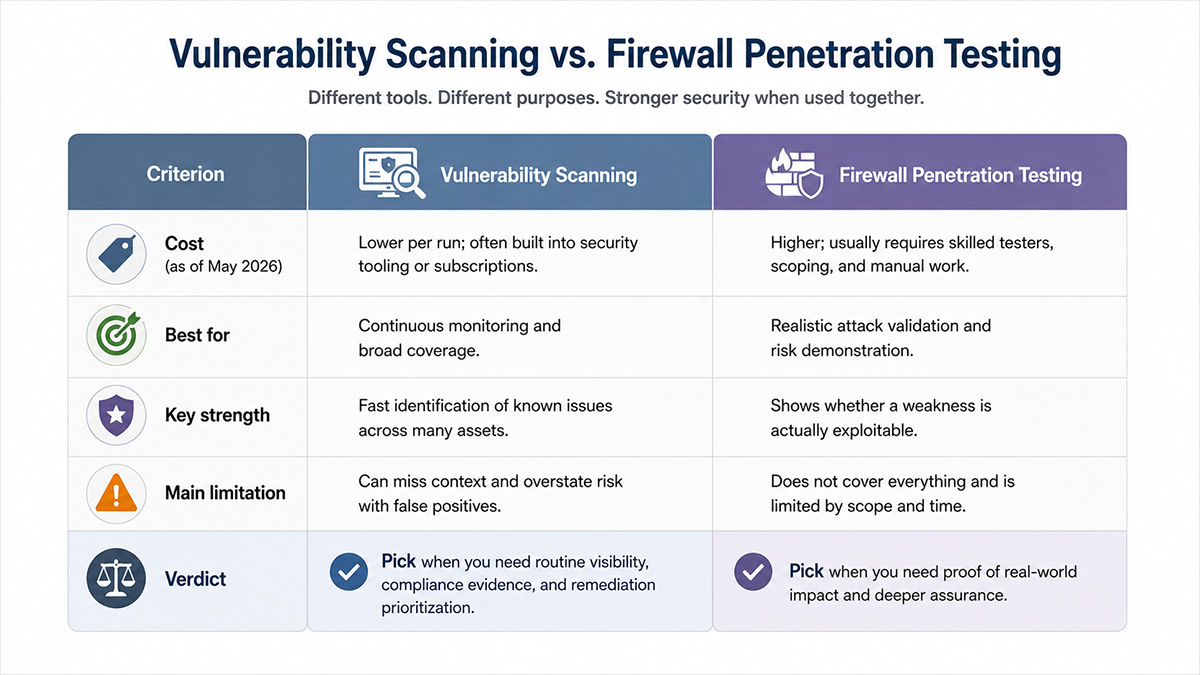
| Criterion | Vulnerability Scanning | Firewall Penetration Testing |
|---|---|---|
| Cost (as of May 2026) | Lower per run; often built into security tooling or subscriptions | Higher; usually requires skilled testers, scoping, and manual work |
| Best for | Continuous monitoring and broad coverage | Realistic attack validation and risk demonstration |
| Key strength | Fast identification of known issues across many assets | Shows whether a weakness is actually exploitable |
| Main limitation | Can miss context and overstate risk with false positives | Does not cover everything and is limited by scope and time |
| Verdict | Pick when you need routine visibility, compliance evidence, and remediation prioritization. | Pick when you need proof of real-world impact and deeper assurance. |
What Firewall Vulnerability Scanning Actually Does
Firewall vulnerability scanning is an automated process that checks firewall devices, configurations, exposed services, firmware versions, and rule sets for known weaknesses. The scanner is not trying to outsmart the firewall; it is trying to identify conditions that match a known issue, such as a default credential, weak encryption setting, unsupported firmware, or an exposed management port.
That is why scanning is so useful for security testing and routine network defense. A well-run scan can flag open ports that do not belong, detect version drift after an upgrade, and surface rules that are too permissive for the environment. In practice, teams use scanning to keep firewall hygiene from slipping between major projects.
Most scan outputs are ranked by severity, often combining CVSS scoring, asset criticality, and policy logic. That ranking matters because a long report is useless if nobody knows what to fix first. A scan report can also include CVE references, compliance gap indicators, and remediation guidance, which makes it valuable for audits and for operational change control.
How scanners find problems
Scanners usually compare what they observe against a database of known patterns. They may probe open ports, inspect banners, review rule metadata, and look for configuration states that violate a baseline. Some platforms perform authenticated checks, which gives them better visibility into firmware and local settings, while unauthenticated checks are better for externally exposed surfaces.
- Misconfigurations such as overly broad allow rules or missing logging
- Outdated firmware that may contain published vulnerabilities
- Default credentials or weak administrative protections
- Unnecessary open ports on the firewall or adjacent systems
- Weak encryption or unsupported protocols
For teams learning through the CompTIA Cybersecurity Analyst (CySA+) (CS0-004) course from ITU Online IT Training, this is the same mindset used in alert triage: collect the signal, sort the noise, and decide what matters now versus what can wait. The scanner gives you the first pass. The analyst still has to interpret it.
“A scanner tells you where the fire extinguisher is missing. It does not tell you whether the building can still burn down.”
For official guidance on vulnerabilities and remediation workflows, the National Institute of Standards and Technology and the NIST Cybersecurity Resource Center are worth keeping close. NIST publications such as the SP 800 series remain the backbone for many security assessment programs.
What Firewall Penetration Testing Actually Does
Firewall penetration testing is a controlled adversarial simulation that attempts to exploit weaknesses in firewall defenses. The purpose is not to list every possible issue. The purpose is to answer a harder question: can a real attacker bypass, manipulate, or abuse the firewall to gain access, move laterally, or disrupt services?
This is where penetration testing differs sharply from scanning. A scanner can say a rule is risky. A pen test tries to prove whether that risk is exploitable in the live environment. That often means manual testing, packet analysis, rule evasion attempts, traffic spoofing, and checking whether a chained weakness creates a usable attack path.
Good testers do more than push buttons. They think like defenders and attackers at the same time. They may use network security knowledge, inspect packet flows, and test segmentation boundaries to see whether the firewall behaves as intended under pressure. The report then focuses on business impact, exploitability, and likely attacker outcome rather than a raw checklist of issues.
What real testing looks like
In a firewall pen test, the tester may attempt to map exposed services, validate rule behavior under different traffic types, and probe whether policy exceptions can be abused. If the environment allows it, the tester may also verify whether remote administration surfaces are exposed, whether internal zones are truly isolated, and whether a stateful rule behaves differently than expected when traffic is fragmented or spoofed.
- Port probing to validate exposure and service behavior
- Rule evasion attempts to see whether controls can be bypassed
- Traffic spoofing to test trust assumptions
- Segmentation testing to challenge network boundaries
- Chained exploitation to see whether multiple small weaknesses create a serious breach path
Note
Firewall pen testing should be scoped, approved, and coordinated. The point is controlled validation, not chaos in production.
For official certification-aligned context on adversarial testing, the CompTIA® CySA+ official certification page is a useful reference for the defensive analysis mindset that supports this work. For methodology, OWASP testing guidance and MITRE ATT&CK are also useful sources of attacker tradecraft and defensive mapping.
What Is the Difference Between Scanning and Penetration Testing?
The difference is simple: scanning identifies known issues, while penetration testing validates whether those issues can be exploited. A scan is about breadth and repeatability. A pen test is about depth and adversarial proof.
That distinction matters because a firewall can look clean on paper and still fail under realistic attack conditions. It also matters in the other direction: a scanner may flag a condition that turns out to be harmless once context, segmentation, or compensating controls are considered. One method is not a replacement for the other.
Breadth versus depth
Scanning is broad. It can touch many devices, interfaces, and rulesets quickly. That makes it ideal for vulnerability scanning across the perimeter, branch firewalls, internal segmentation firewalls, and cloud security gateways. Pen testing is narrower but deeper. It focuses on a particular target set and drives toward proof.
- Scanning covers more assets faster
- Pen testing goes deeper on selected targets
- Scanning is usually automated
- Pen testing mixes tools with human reasoning
- Scanning is recurring and routine
- Pen testing is periodic and carefully planned
According to the Cybersecurity and Infrastructure Security Agency (CISA), asset visibility and timely remediation are foundational to reducing exposure. That principle is exactly why scanning and penetration testing work best together rather than as substitutes.
Scope and Coverage: Broad Visibility vs Targeted Attack Simulation
Scope is where the decision often changes. A vulnerability scan can cover a large environment in a short window, which makes it excellent for finding unknown assets, stale rules, and common exposure patterns. If a firewall was added without proper inventory tracking, a scan may reveal it before a human even notices it exists.
A penetration test, by contrast, is deliberately narrow. It may focus on one firewall appliance, one network zone, or one business scenario such as external perimeter access, remote administration exposure, or internal segmentation bypass. That constraint is not a weakness. It is what makes the test realistic, controlled, and useful.
Why scoping matters
Careful scoping keeps a pen test from becoming a production incident. It also makes results easier to interpret because the tester is working against a defined target, not just wandering through the environment. Scans do not need that same precision to be useful, which is why they are often the first step in a broader assessment program.
- Use scanning to establish visibility across the full firewall estate.
- Use penetration testing to challenge the highest-risk paths in detail.
- Use both after major rule changes or architecture changes.
For organizations that need help validating asset coverage, NIST network security guidance reinforces a practical point: you cannot defend what you have not identified. This is also where network mapping becomes important. A firewall assessment is only as complete as the inventory behind it.
What Tools Are Commonly Used in Firewall Testing?
Tool choice depends on the question you are trying to answer. Firewall testing for vulnerability management often starts with scanners such as Nessus, Qualys, OpenVAS, and Rapid7 InsightVM. These platforms are designed to compare observed settings against known weaknesses, policy baselines, and software advisories.
Penetration testers use a different mix. Nmap is common for discovery and service validation. Metasploit may be used for controlled exploitation when authorized. Burp Suite is helpful when firewall rules intersect with web traffic or proxy behavior. Packet-crafting utilities and custom scripts help test edge cases that generic scanners often miss.
What each tool type does well
| Scanner tools | Best for version detection, port enumeration, compliance checks, and repeated baseline comparisons. |
|---|---|
| Pen test tools | Best for active validation, traffic manipulation, and controlled exploitation attempts. |
Both approaches benefit from logging, packet capture, and network mapping. Without that context, it is easy to misunderstand a result. A firewall rule that looks permissive in a report may actually be constrained by identity, zone, or upstream control. Likewise, a “clean” scan may still hide a manually exploitable path through a chained weakness.
For official protocol behavior and packet-level specifics, vendor docs and standards matter more than blog opinions. Cisco, Microsoft, and AWS all publish reliable guidance for the platforms they support, and those docs are better than generic advice when a firewall rule interacts with cloud routing or identity-aware policy.
What Can Each Approach Reveal About Firewall Security?
Scanning can reveal misconfigurations, outdated firmware, unnecessary exposure, and compliance drift. That is already valuable because firewall problems often start as simple mistakes: an old admin rule left in place, a temporary exception never removed, or a firmware update delayed until after a risk review that never came.
Penetration testing reveals something different. It shows whether those weaknesses are actually exploitable in context. A permissive rule may be harmless if it is locked behind a tightly controlled bastion. The same rule may be critical if it exposes a management plane to a reachable network segment. The difference is not theoretical; it changes how the risk should be handled.
Examples of findings that matter
- Scanning reveals exposed services, stale signatures, and missing patches.
- Pen testing reveals whether exposed services create a usable entry point.
- Scanning reveals policy drift from the approved baseline.
- Pen testing reveals whether policy drift enables lateral movement or privilege abuse.
In a real-world incident, a firewall issue rarely exists alone. It is often paired with weak segmentation, an exposed management interface, or a business exception that grew too broad. That is why pentesters test chained conditions and why analysts trained in the CySA+ skill set think in terms of attack paths instead of single alerts.
A good firewall report says what is exposed. A good penetration test says what an attacker can do with it.
For threat pattern context, MITRE ATT&CK is useful for mapping adversary behaviors to defense gaps. For findings tied to known weaknesses, CVE references help connect technical issues to public vulnerability records.
What Are the Limitations of Vulnerability Scanning?
Scanning is efficient, but it has blind spots. A scanner may generate false positives, miss a weakness that requires authentication, or misread a rule because it cannot fully model how traffic behaves in a live environment. That is especially true when traffic is encrypted, uses custom protocols, or depends on stateful behavior that only becomes obvious after the session evolves.
Another limitation is context. Scanners can tell you that a rule is broad, but they may not know whether a business exception is temporary, whether compensating controls exist, or whether a specific access path is actually reachable. That makes scanning excellent for hygiene and less reliable for proving exploitability.
Where scans struggle most
- Encrypted traffic that hides useful detail from inspection
- Custom protocols that do not match standard signatures
- Complex stateful behavior that changes over time
- Context-dependent access controlled by identity or upstream systems
- Chained abuse that only becomes obvious after multiple steps
Warning
A clean scan does not prove the firewall is secure against a determined attacker. It only means the scanner did not detect a known problem in the areas it could see.
For a disciplined scanning program, follow the vendor guidance for your firewall platform and compare results against trusted baselines such as the CIS Benchmarks. That gives you a better shot at separating real issues from tool noise.
What Are the Limitations of Penetration Testing?
Penetration testing is powerful, but it is not magic. It is time-boxed, scoped, and dependent on the tester’s skill and assumptions. A good team can still miss something simply because the engagement did not cover that path, the window was too short, or the environment changed after the test began.
That is why a successful pen test should never be treated as proof that the firewall is “secure.” It only proves what was tested, under the conditions that existed during the engagement. It does not eliminate the need for security testing, monitoring, or ongoing remediation.
Blind spots you should expect
- Time limits prevent total coverage
- Scope limits exclude some systems by design
- Tester skill affects what is discovered
- Point-in-time results go stale after changes
- Broad hygiene issues may be missed if the test focuses narrowly on one path
For official risk management concepts, NIST SP 800 publications remain the clearest public reference set. For organizations that operate under formal assurance programs, those documents help frame pen test findings as evidence, not a final verdict.
When Should You Use Each One?
Use vulnerability scanning when you need continuous monitoring, baseline security checks, asset discovery, compliance support, and routine firewall hygiene. It is the better choice for broad coverage and frequent repetition. If you manage many firewalls, many sites, or a mix of cloud and on-premises controls, scanning is the practical default.
Use penetration testing when you need to validate critical controls, test a real-world attack scenario, or measure actual business risk. This is especially important for external perimeter firewalls, sensitive internal segmentation points, and firewall changes that could affect access to high-value systems.
When scanning is the right call
Scanning is the right move after firmware updates, during regular compliance cycles, and whenever you need fast visibility into exposure across the environment. It also supports vulnerability scanning workflows that feed ticketing, patching, and exception management.
When penetration testing is the right call
Pen testing is the right move before major go-live events, after network redesigns, and when leadership needs evidence of what an attacker could actually achieve. If a rule change could expose finance systems, regulated data, or remote administration, a pen test is usually justified.
For regulated environments, the cadence often differs by requirement. PCI DSS expects regular testing and validation of security controls, while other frameworks may call for recurring assessments and documented remediation. The exact schedule depends on your control framework, but the principle stays the same: scan often, test deeply when the risk warrants it.
For compliance alignment, consult the PCI Security Standards Council and framework guidance from your governing body. That keeps assessment timing tied to real obligations instead of guesswork.
Decision Criteria: What Should Change Your Choice?
The right answer is not “always scan” or “always pen test.” The right answer depends on what you are trying to prove, how much risk you carry, and how much time you have to remediate findings. Most organizations should use both, but one usually leads.
Three factors usually decide it: use case, budget, and maturity. If the goal is ongoing visibility, scanning wins. If the goal is attack validation, penetration testing wins. If the team is still struggling with asset inventory, scanning first is almost always the better starting point.
- Use case — Are you looking for broad exposure or proof of exploitability?
- Budget — Do you need a low-cost recurring control or a higher-cost expert engagement?
- Team experience — Can your staff interpret scan data and remediate quickly?
- Ecosystem fit — Does your firewall stack support authenticated checks and log correlation?
- Risk level — Are you protecting sensitive data, regulated systems, or high-availability services?
| If your problem is visibility | Start with scanning and baseline the estate. |
|---|---|
| If your problem is proof | Use penetration testing to validate the attack path. |
According to the Bureau of Labor Statistics, information security roles remain in sustained demand, which reflects how often organizations need both detection and validation work. Salary snapshots from Glassdoor and PayScale also continue to show a premium for analysts who can interpret technical findings and translate them into operational action.
Which Approach Should You Pick First?
Pick the first approach based on what your team can act on immediately. A perfect assessment that no one can remediate is wasted effort. A smaller assessment that leads to fast corrective action is far more valuable.
Pick vulnerability scanning first
Choose scanning first if you need ongoing visibility, have a large environment, or are trying to establish a baseline. It is also the safer starting point if your firewall estate is poorly documented or if the team needs to discover unknown exposure before attempting deeper validation.
Pick penetration testing first
Choose penetration testing first if you already know the high-risk paths and need evidence of real attacker impact. That is common before a major release, after a firewall redesign, or when executives need a concrete answer on whether a control can be bypassed.
Pick vulnerability scanning when you need continuous coverage and quick remediation cycles; pick firewall penetration testing when you need to prove exploitability and business impact.
How Should You Interpret and Prioritize the Results?
Interpret scan results by separating noise from action. Informational findings can document hygiene issues. Low-risk issues may be tracked in normal maintenance cycles. Critical findings should be validated quickly, especially if they involve exposed management interfaces, known exploits, or weak segmentation around sensitive assets.
Pen test findings should be prioritized by exploitability, business impact, and likelihood of attack. A flaw that is technically interesting but unreachable may sit below a path that directly exposes customer data or internal admin access. That is why remediation rankings should reflect the environment, not just the technical label.
- Asset criticality — How valuable is the system behind the firewall?
- Exposure level — Is the issue reachable from untrusted networks?
- Compensating controls — Are there identity checks, segmentation, or monitoring layers in place?
- Exploitability — Can the issue be demonstrated in a controlled way?
- Business impact — What happens if this control fails?
Use a plain-language summary for leadership. “Rule is permissive” is technical. “Rule allows unauthorized access to the admin interface from a user network” is a business risk statement. The second version gets funded faster because people can understand the consequence.
The ISACA COBIT framework is a useful reference when you need to connect technical findings to governance, risk, and control objectives. That is especially helpful when firewall testing results have to move through audit, operations, and executive review.
What Are the Best Practices for a Stronger Firewall Assessment Program?
The strongest firewall assessment program combines automated scans, manual testing, configuration reviews, and rule recertification. That is how you catch both the obvious issues and the subtle ones. No single method gives you full coverage.
Start with an accurate asset inventory. If you do not know every firewall, interface, zone, and policy exception, you will miss something. Then build a repeatable schedule: scan often, test deeply after major changes, and review rules on a fixed cadence so old exceptions do not linger forever.
Practical operating habits
- Document every firewall and its ownership.
- Run recurring scans against the full estate.
- Test after major rule changes or software upgrades.
- Review rule exceptions before they become permanent.
- Retest fixes to confirm remediation worked.
Collaboration matters here. Security teams, network engineers, and infrastructure owners need a shared view of what changed, why it changed, and how the risk was reduced. That is where operational friction drops and remediation speed improves. It is also where the best operational security training pays off, because analysts learn how to communicate findings without turning every ticket into a fight.
For firewall policy and configuration hardening, use vendor documentation from your platform provider, then validate against recognized benchmarks such as CIS. For cloud-connected environments, consult the official docs from Microsoft, AWS, or Cisco rather than relying on generic checklists.
What Are the Most Common Misconceptions?
One common mistake is thinking a clean scan means the firewall is secure. It does not. It means the scanner did not find a known issue in the area it could assess. If the test was unauthenticated, limited, or blind to a custom path, the result is helpful but incomplete.
Another mistake is thinking a successful penetration test means the firewall is useless. It does not. It means one set of weaknesses was proven exploitable under specific conditions. That is useful because it shows what must be fixed, not because it invalidates the entire control.
- Scanning is not just compliance when it is used to drive remediation.
- Pen testing is not random hacking when it is scoped and authorized.
- One tool does not replace a program because security is layered.
- One assessment does not prove permanence because configurations change.
These misconceptions are why teams sometimes argue over stateless firewall vs stateful behavior without testing the actual rule path. A firewall may look strong in design but behave differently under the exact traffic patterns attackers use. That is why both measurement and validation matter.
Key Takeaway
- Vulnerability scanning finds known issues at scale and supports continuous firewall hygiene.
- Penetration testing validates whether a firewall weakness is actually exploitable in a real attack path.
- Scanning is broad and repeatable; penetration testing is narrower, deeper, and more manual.
- The strongest assessment programs use both methods, not one or the other.
- Firewall security improves when testing, remediation, and monitoring are ongoing.
CompTIA Cybersecurity Analyst CySA+ (CS0-004)
Learn to analyze security threats, interpret alerts, and respond effectively to protect systems and data with practical skills in cybersecurity analysis.
Get this course on Udemy at the lowest price →Conclusion
The key difference is straightforward: vulnerability scanning finds known issues at scale, while firewall penetration testing validates whether those issues can actually be exploited. One gives you breadth and repeatability. The other gives you depth and proof.
Both are valuable. Scans are better for continuous visibility, hygiene, and compliance support. Pen tests are better for deeper assurance, realistic attack simulation, and clear business risk demonstration. Mature teams use both because each one covers the other’s blind spots.
Pick vulnerability scanning when you need continuous visibility and rapid remediation; pick firewall penetration testing when you need proof that a control can withstand a determined attacker. If your goal is stronger network defense, treat assessment as a cycle: test, fix, retest, and monitor.
CompTIA® and CySA+ are trademarks of CompTIA, Inc.
