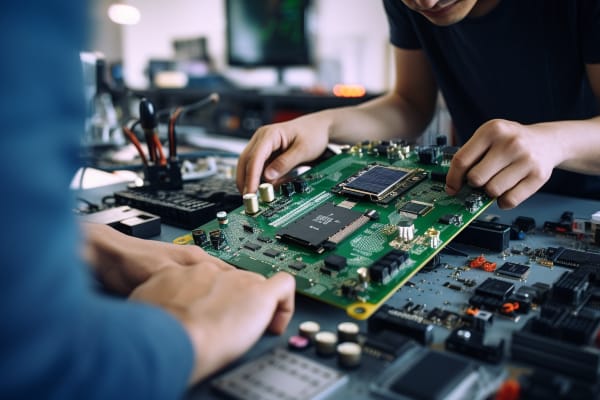
Computer hardware engineering starts with a simple idea: you are learning how to design, test, and improve the physical parts that make computers work. If you are asking are computer engineers in demand, the short answer is yes, but demand is strongest for candidates who can prove they understand circuits, troubleshooting, testing, and system-level thinking. That is why computer hardware engineer education is more than a degree checkbox. It is the path that turns interest into credible engineering skill.
CompTIA Cloud+ (CV0-004)
Learn practical cloud management skills to restore services, secure environments, and troubleshoot issues effectively in real-world cloud operations.
Get this course on Udemy at the lowest price →Quick Answer
Computer hardware engineers are in demand when they can design, test, and troubleshoot real systems. The best path usually starts with a bachelors of computer engineering or electrical engineering, plus lab work, projects, and internships. Employers value practical problem solving because hardware failures affect performance, reliability, and cost across entire products.
Quick Procedure
- Choose a hardware-focused degree path and map the core courses.
- Build foundational skills in math, physics, digital logic, and circuits.
- Practice in labs with measurement tools, testing, and documentation.
- Complete small projects that show troubleshooting and iteration.
- Get experience through internships, clubs, research, or maker spaces.
- Prepare a portfolio and resume that prove hands-on hardware ability.
- Keep learning industry tools, testing methods, and system design basics.
| Primary Path | Bachelor of computer engineering or electrical engineering as of July 2026 |
|---|---|
| Core Focus | Circuits, digital logic, computer architecture, testing, and troubleshooting as of July 2026 |
| Best Entry Experience | Labs, projects, internships, co-ops, and research as of July 2026 |
| Key Tools | Multimeter, oscilloscope, logic analyzer, power supply, schematic tools as of July 2026 |
| Typical Work Areas | Processors, boards, memory, storage interfaces, sensors, and power delivery as of July 2026 |
| Common Adjacent Roles | Firmware, embedded systems, QA, manufacturing, and systems engineering as of July 2026 |
| Career Signal | Strong portfolios and practical problem solving matter as much as grades as of July 2026 |
What Computer Hardware Engineers Actually Do
Computer hardware engineers design and improve the physical components inside computing systems. That includes circuit boards, processors, memory subsystems, power delivery, sensors, and the interfaces that let those parts communicate reliably.
In practice, the job is not just drawing schematics. It is testing why a system fails to boot, tracing signal noise on a line, reducing heat on a board, or finding out why a device browns out under load. That kind of work shows why computer and hardware engineering is a systems discipline, not a narrow electronics job.
Where the work changes by industry
In consumer electronics, hardware engineers often focus on size, cost, battery life, and manufacturability. In aerospace or medical devices, reliability and traceability matter more because failure can affect safety and compliance. Industrial systems may prioritize ruggedness, long lifecycle support, and resistance to temperature or vibration.
Hardware engineers also collaborate closely with firmware, software, manufacturing, and quality assurance teams. A board may work perfectly in the lab and still fail in production if thermal conditions, tolerances, or assembly issues are not addressed.
Hardware engineering is where abstract theory meets measurable reality. If the voltage is wrong, the system does not care what the design intent was.
- Processors: performance, thermal behavior, and bus compatibility.
- Circuit boards: layout, routing, component placement, and signal integrity.
- Memory systems: timing, bandwidth, stability, and error handling.
- Storage interfaces: throughput, controller behavior, and data reliability.
- Power delivery: regulation, current draw, heat, and transient response.
Why Computer Hardware Engineering Education Matters
Computer hardware engineer education matters because hardware problems are not solved well by guesswork. A small design mistake can cascade into failure across a product line, and even a seemingly minor issue such as poor decoupling or a noisy clock signal can turn into instability, crashes, or expensive rework.
Formal education gives you the math, physics, and systems thinking needed to diagnose those issues instead of reacting to them. It teaches you how to reason about voltage, current, timing, heat, and component limits, which is exactly the kind of foundation employers expect when they are attracting hardware engineers for critical roles.
Education builds credibility and access
For many entry-level roles, employers want evidence that a candidate can handle both theory and practice. A degree, especially a bachelors of computer engineering, often serves as the first filter for internships and new graduate roles because it signals exposure to circuits, digital systems, and lab work.
Lab time matters just as much as classroom time. You can read about failures all day, but until you have measured a noisy line with an oscilloscope or debugged a board that will not power on, the work stays abstract.
Note
Hardware education is not just about passing courses. It is about building the ability to isolate failures, explain tradeoffs, and make decisions that hold up under real operating conditions.
What Is the Best Educational Path for Hardware Engineering?
The best path into hardware depends on your goals, budget, and time. For most people, a bachelors of computer engineering is the most direct route because it combines computing fundamentals with electronics, digital logic, and hardware design. Electrical engineering can also work well, especially if the program includes computer architecture, embedded systems, or digital design.
Associate degrees and certificates can help you build momentum, but they usually do not replace a four-year degree for full hardware engineering roles. They are better for technician paths, lab support, or as stepping stones while you decide whether comp eng is the right long-term fit.
| Computer engineering | Best for students who want a balance of hardware, software, and systems design. |
|---|---|
| Electrical engineering | Best for students who want deeper electronics theory and broader hardware flexibility. |
| Associate degree | Useful for technician-level work or as a lower-cost launch point into further study. |
| Self-study | Good for skill building, but usually not enough on its own for most entry-level hardware engineering roles. |
If cost is the main concern, choose a program that gives you access to labs, faculty mentorship, and project-based coursework. If your goal is specialized design work later, graduate study can help, but it is not required to start in hardware. The most important factor is whether the path gives you enough practical exposure to prove you can solve real problems.
For current labor-market context, the U.S. Bureau of Labor Statistics BLS Occupational Outlook Handbook remains a useful reference for electrical and electronics engineering roles, while NIST provides the technical standards mindset that shows up in hardware validation and reliability work.
What Core Subjects Should You Learn First?
Strong hardware engineers usually start with math, physics, and digital fundamentals. Systems thinking is the ability to understand how each part affects the whole, and it matters because a board, chip, cable, and power rail all interact. If one assumption is wrong, the entire design can fail.
Algebra and calculus help with signal behavior, power calculations, and design tradeoffs. Physics matters because circuits are physical systems, not just diagrams. Digital logic, computer architecture, and microprocessors connect theory to the actual way devices process data.
Programming still matters
Even in a hardware-focused role, basic Programming helps you understand how code interacts with devices. Hardware engineers often work with test scripts, firmware expectations, and debugging tools that depend on scripting or simple automation.
Communication skills are another underrated subject. If you cannot write a clear test result, document a failure, or explain why a design change matters, you will slow down every team around you.
- Algebra: used for voltage, current, power, and tolerance calculations.
- Calculus: useful for signal analysis and change over time.
- Physics: essential for electricity, magnetism, and circuit behavior.
- Digital logic: the basis for gates, timing, and binary operations.
- Computer architecture: helps you understand how processors and memory work together.
What Hands-On Lab Skills Build Real Credibility?
Lab work turns theory into engineering judgment. When you assemble a circuit, measure it, break it, and fix it, you learn how hardware actually behaves under load. That is the difference between knowing the concept and being able to do the work.
Common lab activities include soldering, breadboarding, component testing, and debugging boards that do not behave as expected. In a real environment, you may use a multimeter to check continuity, a power supply to verify current draw, or an oscilloscope to trace timing issues.
Tools you should expect to use
A multimeter is essential for checking voltage, resistance, and continuity. An oscilloscope helps you see changing signals, which is critical when you are tracking timing problems or noisy power. A logic analyzer is especially useful when you are working with digital buses or embedded systems.
Good lab habits matter as much as the tools. Label your wires, record the test setup, note the component values, and repeat the experiment before you conclude anything. Those habits make your work credible and reproducible.
- Assemble a simple circuit and verify each connection before powering it on.
- Measure voltage, current, and continuity at key points in the circuit.
- Observe signal behavior with an oscilloscope or logic analyzer when the circuit misbehaves.
- Change one variable at a time so you can isolate the root cause.
- Document the failure, the fix, and the final result in a lab notebook.
OWASP is better known for security, but the same discipline applies in lab environments: test methodically, verify assumptions, and avoid drawing conclusions from one data point.
How Do Projects Help Beginners Stand Out?
Projects matter because they show what a transcript cannot. A candidate with a few solid, well-documented builds often looks more job-ready than someone with only classroom exposure. That is especially true in computer hardware engineering, where employers want proof that you can troubleshoot, iterate, and finish something.
Start with simple work such as LED circuits, sensor modules, or a microcontroller build. Then move toward projects that require you to measure performance, identify failures, and improve stability. A project does not need to be fancy to be useful. It needs to show that you can think like an engineer.
What to include in every project write-up
Document the goal, the parts used, the wiring diagram, and the test results. Include photos of the setup, what failed, how you debugged it, and what you changed after each iteration. That documentation is valuable because it demonstrates process, not just outcome.
Use GitHub for code, a personal site for summaries, or a portfolio page that shows how your design thinking evolved. If you are aiming for comp eng roles, even a basic embedded project can help show that you understand how Embedded Systems connect hardware and software.
- Beginner: LED blink circuit, temperature sensor, simple power test.
- Intermediate: microcontroller-based monitoring project, motor control, data logging.
- Advanced: board prototype, performance optimization, reliability testing.
How Can You Build Experience Before Your First Job?
Internships, co-ops, and research roles are the fastest way to build relevant experience. They expose you to real constraints such as deadlines, documentation standards, design reviews, and test failures that do not show up in class.
Campus labs, robotics clubs, and hardware teams can also be valuable. If you are part of a robotics club, you will likely touch circuits, sensors, motors, power systems, and debugging tools in the same project. That is practical experience, even if it is not a formal job title.
Other places to gain experience
Maker spaces, open-source hardware communities, and faculty-led projects can help you practice problem solving without waiting for a perfect internship. These settings are useful when you want to strengthen your confidence before applying to jobs.
Networking still matters. Professors, alumni, local engineers, and industry groups can point you toward opportunities and also help you understand which skills matter most in your region.
Employers do not just hire potential. They hire evidence that you can learn quickly, work carefully, and solve problems without creating new ones.
- Internships: strongest signal for entry-level readiness.
- Co-ops: extended exposure to real engineering workflows.
- Research: good for analysis, testing, and deeper technical curiosity.
- Clubs: useful for collaboration and project completion.
- Maker spaces: helpful for low-cost experimentation and iteration.
What Tools, Software, and Technical Environments Should You Know?
You do not need every industry tool on day one, but you should recognize the main categories. Firmware is software that sits close to the hardware and helps devices boot, communicate, and respond to commands. Knowing that boundary helps you understand why a hardware issue can sometimes look like a software bug.
Common design environments include schematic capture and simulation tools, while testing environments include measurement hardware and debug stations. In a learning setting, the goal is not to master every vendor platform. The goal is to become comfortable reading schematics, following signal paths, and checking assumptions with data.
Version control and documentation systems are also part of the workflow. Hardware teams need traceability, especially when they are changing revisions, tracking test results, or coordinating with manufacturing.
- Schematic tools: used to design and review circuit connections.
- Simulation tools: used to test behavior before building hardware.
- Measurement tools: used to validate voltage, timing, and signal quality.
- Documentation systems: used to preserve revision history and test notes.
- Version control: useful for code, scripts, and design-related files.
For a practical learning bridge, the CompTIA Cloud+ (CV0-004) course from ITU Online IT Training can help you build the troubleshooting mindset that hardware engineers also need when they diagnose service failures, dependencies, and system behavior. Cloud operations and hardware engineering are different fields, but both reward disciplined problem isolation.
How Is Hardware Engineering Different From Related Tech Careers?
Hardware engineering focuses on the physical components of a computing system, while software engineering focuses on instructions that run on those components. That difference sounds simple, but it changes the entire workflow. Hardware changes are slower, more expensive, and often require lab testing or manufacturing revision.
Electrical engineering is broader than hardware engineering and includes power systems, communications, analog design, and more. Computer hardware roles are usually narrower and more computing-focused, especially when they involve processors, boards, memory, and device integration.
Where the overlap happens
Hardware roles often overlap with firmware, embedded systems, and systems engineering. A hardware engineer may need to work with a firmware engineer to validate boot behavior or with a systems engineer to ensure the board fits the whole product architecture. That overlap is why strong Systems Thinking matters.
If you like physical systems, test equipment, and root-cause analysis, hardware may fit better than pure software. If you prefer faster iteration and code-only work, software may feel more natural. Some students start in one area and move into the other after they see where their strengths are.
| Hardware engineering | Best for people who want to design and test physical computing components. |
|---|---|
| Software engineering | Best for people who want to build applications, services, and code-heavy products. |
| Electrical engineering | Best for people who want broader electronics and power-system options. |
| Firmware or embedded work | Best for people who want to bridge software behavior and device-level control. |
Are Computer Engineers in Demand?
Yes, are computer engineers in demand is a fair question, and the answer is generally yes when the role combines hardware knowledge with testing, reliability, and product development skills. Demand is not identical across every region or industry, but companies still need people who can design boards, debug devices, and support increasingly complex computing systems.
Hardware engineers are needed in chip design, consumer devices, industrial equipment, telecom infrastructure, medical devices, automotive systems, and aerospace. Those industries continue to rely on specialized hardware because reliability, power efficiency, and performance still matter in ways software alone cannot solve.
What the market signals
The U.S. Bureau of Labor Statistics Occupational Outlook Handbook is the best place to check official role outlook data for closely related electrical and electronics engineering jobs. For workforce context, the CISA mission also reflects how much modern systems depend on secure, reliable technology across sectors.
Demand can rise and fall with product cycles, semiconductor investment, and regional manufacturing trends. But the long-term need for engineers who can understand hardware, troubleshoot failures, and support product quality remains strong.
Warning
Hardware demand is not the same as easy hiring. Employers want proof of lab skill, documentation discipline, and the ability to explain how you found and fixed a problem.
What Challenges Do Students Face and How Can They Overcome Them?
Hardware can feel harder than software because the feedback loop is slower. You may build something correctly and still see failure because of a wiring mistake, noisy power, a bad component, or a design assumption that does not hold up physically.
Math anxiety, limited lab access, and expensive tools are also common barriers. The fix is usually not to wait for the perfect setup. It is to start with simple projects, use affordable components, and practice one skill at a time until the process becomes familiar.
How to keep moving when prototypes fail
Broken prototypes are part of the job. The best engineers do not avoid failure; they shorten the time between failure and diagnosis. Take notes, change only one variable, and keep a clear record of what changed. That habit is what turns mistakes into engineering progress.
Consistency matters more than intensity. A student who spends two focused hours each week building and testing often learns more than someone who crams for one weekend and forgets everything afterward.
- Problem: math feels overwhelming. Fix: practice with real circuit examples.
- Problem: no lab access. Fix: use low-cost starter kits and simulation tools.
- Problem: repeated failure. Fix: isolate one change at a time.
- Problem: expensive tools. Fix: borrow, share, or start with essentials.
What Is a Step-By-Step Roadmap From Beginner to Job-Ready Candidate?
A job-ready hardware candidate follows a sequence, not a leap. Start with the basics, build confidence in labs, document your work, and then add experience that looks like the real world. That is the most practical route for anyone starting from zero.
- Start with foundations. Learn algebra, physics, digital logic, and circuit basics before chasing advanced projects.
- Take hardware-focused coursework. Prioritize computer architecture, electronics, and lab-based classes in your degree path.
- Build small projects. Use simple circuits, sensors, and microcontrollers to practice testing and debugging.
- Document everything. Write down what worked, what failed, and how you fixed it.
- Look for experience. Apply for internships, co-ops, research roles, and campus hardware opportunities.
- Prepare your portfolio. Show project photos, test notes, diagrams, and concise explanations of your decisions.
- Keep learning after graduation. Stay current on tools, standards, and the kinds of hardware problems that show up in industry.
This roadmap also fits well with courses that teach operational troubleshooting, like ITU Online IT Training’s CompTIA Cloud+ (CV0-004) course, because the same discipline used to restore a cloud service is useful when you isolate a hardware fault.
What Do Employers Look for in Entry-Level Hardware Candidates?
Employers want more than enthusiasm. They want evidence that you can handle circuits, testing, troubleshooting, and teamwork without needing constant supervision. A candidate who can describe a failure clearly often stands out immediately.
Strong entry-level candidates usually show technical curiosity, attention to detail, and a willingness to verify assumptions. They understand that hardware work requires patience because every change must be tested, measured, and documented.
The most valuable signals
- Technical skill: basic circuits, measurement, and troubleshooting.
- Documentation: clear notes, diagrams, and version history.
- Communication: ability to explain a failure and a fix.
- Teamwork: willingness to coordinate with firmware, QA, and manufacturing.
- Curiosity: interest in how the full product works, not just one part.
Employers also like candidates who can connect their education to real outcomes. If your portfolio shows that you reduced noise, improved stability, or fixed a recurring failure, that is stronger than simply listing coursework. That is the difference between having knowledge and being able to apply it.
FAQ: Computer Hardware Engineer Education and Career Start
Do I need a computer engineering degree to get started? A computer engineering degree is one of the most direct paths, but electrical engineering can also lead into hardware roles if the program includes digital design, circuits, and lab work.
Is self-study enough? Self-study helps, but most entry-level hardware roles still expect formal education or equivalent evidence of practical skill. Projects, labs, and internships make self-study much more credible.
How much hands-on experience do I need? Enough to show that you can build, test, debug, and document a small system without outside help. A few strong projects are better than a long list of unfinished experiments.
What is the fastest way to become job-ready? Choose a hardware-focused degree path, build lab skills, create projects, and look for internships early. That combination gives you the strongest foundation for computer and hardware engineering work.
Why is hardware harder for beginners? Because the feedback is slower and the failures are physical. One incorrect connection can make an entire system behave unpredictably.
Key Takeaway
- Computer hardware engineers are in demand when they can prove design, testing, and troubleshooting ability.
- A bachelors of computer engineering or electrical engineering is the most common starting point for hardware roles.
- Lab work and projects matter because they show real debugging skill, not just classroom knowledge.
- Employers value documentation and systems thinking as much as they value technical concepts.
- Consistency beats perfection: small, repeatable practice is the fastest way to build credibility.
CompTIA Cloud+ (CV0-004)
Learn practical cloud management skills to restore services, secure environments, and troubleshoot issues effectively in real-world cloud operations.
Get this course on Udemy at the lowest price →Conclusion
Computer hardware engineering is a practical, high-skill path built on education, hands-on work, and persistence. If you want to answer are computer engineers in demand with confidence, the real proof comes from what you can design, test, and explain.
Start with the strongest foundation you can manage, then add labs, projects, and experience that demonstrate your ability to solve real problems. The best hardware candidates are not the ones who know everything. They are the ones who keep learning, keep testing, and keep improving until the system works.
If you are ready to begin, pick one step today: enroll in a hardware-focused course, build a simple circuit, or document your first project clearly. That is how a tech journey becomes a career.
CompTIA® and Cloud+™ are trademarks of CompTIA, Inc.
