IT projects fail for a simple reason that gets ignored until it is too late: the team delivered the system, but the stakeholders did not feel any value. Scope was closed, the budget was burned, and the timeline was met, yet users still worked around the tool, sponsors questioned the spend, and support teams inherited a mess.
ITSM – Independent Training Based on the ITIL® 4 and Version 5 Framework
Learn essential IT service management skills using the ITIL 4 framework to improve operations, resolve issues efficiently, and prevent future problems.
View Course →Quick Answer
ITIL 4 Drive Stakeholder Value is the ITIL practice module that helps teams design, deliver, and improve stakeholder journeys so projects create real business value, not just completed tasks. It focuses on engagement, expectations, experience, and outcomes across the full service relationship, which is why it is useful for IT projects, service improvements, and customer focus work.
Definition
ITIL 4 Drive Stakeholder Value is the ITIL practice area that explains how to engage stakeholders, shape their journeys, and co-create value through service interactions. It treats value as the result of outcomes, experiences, and perceptions, not just the delivery of a technical output.
That shift matters because project success is not the same as stakeholder success. If you want a practical framework for aligning service delivery with Stakeholder Management, Customer Focus, Service Improvement, and Engagement Strategies, this is where ITIL 4 becomes useful instead of theoretical.
For readers looking for the broader implementation context, the Practical Tips for Implementing ITIL in Small to Medium-Sized Enterprises pillar covers the operating model side. This post goes deeper into the stakeholder side: how value is defined, how journeys are mapped, how communication works, and how continuous improvement keeps value alive after go-live.
| Focus | ITIL 4 Drive Stakeholder Value |
|---|---|
| Primary outcome | Better stakeholder value, adoption, and service experience |
| Key lens | Value co-creation across the service relationship |
| Main use case | IT projects, service transitions, and service improvement |
| Core concern | Expectations, experience, outcomes, and communication |
| Best fit | Teams improving customer focus and engagement strategies |
Understanding Stakeholder Value in IT Projects
Stakeholder value is the business and human benefit a person or group gets from an IT project, and it includes both measurable results and subjective experience. Customers, users, sponsors, partners, and support teams can all judge the same project differently, which is why value cannot be defined by the delivery team alone.
A system can be delivered on time and still fail if it does not improve the business result that justified the work. For example, a new workflow tool may technically go live, but if it increases clicks, slows approvals, or creates confusion, the output exists while the value does not.
Outputs, outcomes, and value are not the same thing
Outputs are what the team produces, such as software, documentation, or infrastructure. Outcomes are the changes those outputs cause, such as faster onboarding, fewer errors, or better compliance.
Value is the combined result of the outcome and how the stakeholder experiences it. A reporting portal that reduces manual work by 20% is valuable, but only if the users trust the data, can access it quickly, and do not need a support ticket to interpret the numbers.
Different stakeholders define value differently
- Executives may care about cost savings, risk reduction, and strategic alignment.
- End users usually care about usability, speed, and fewer daily pain points.
- Support teams often care about reliability, clear escalation paths, and fewer repeat incidents.
- Compliance groups focus on controls, traceability, and audit readiness.
- Partners and vendors may value predictable integration and clean handoffs.
That difference in perspective is where many projects go off track. Requirements sound clear until the team discovers that the sponsor wanted a dashboard for visibility, while the user wanted less manual reconciliation, and the operations team wanted fewer tickets. If those needs are not aligned early, the final product satisfies no one completely.
IT project value is rarely destroyed by one big failure. It is usually lost in small mismatches between what was requested, what was built, and what people actually needed.
According to PMI, stakeholder engagement remains one of the strongest predictors of project success because projects are judged on adoption and business impact, not just delivery effort. That aligns directly with ITIL 4 Drive Stakeholder Value and with modern Stakeholder Management practices.
Why projects struggle to create value
Common failure points are usually predictable. Expectations are unclear, users are not involved early enough, communication is too technical, and feedback arrives only after the damage is done.
- Misaligned expectations create disappointment even when the build is technically correct.
- Weak adoption means the solution exists but the business keeps using workarounds.
- Poor communication creates rumors, fear, and resistance.
- Uncaptured hidden stakeholders lead to surprise objections late in the project.
Value is both objective and subjective. You can measure throughput, error rates, and response times, but you also need to understand whether people feel supported, informed, and confident enough to use the new service. That combination is what makes ITIL 4 relevant to Customer Focus and Service Improvement.
How Does ITIL 4 Drive Stakeholder Value Work?
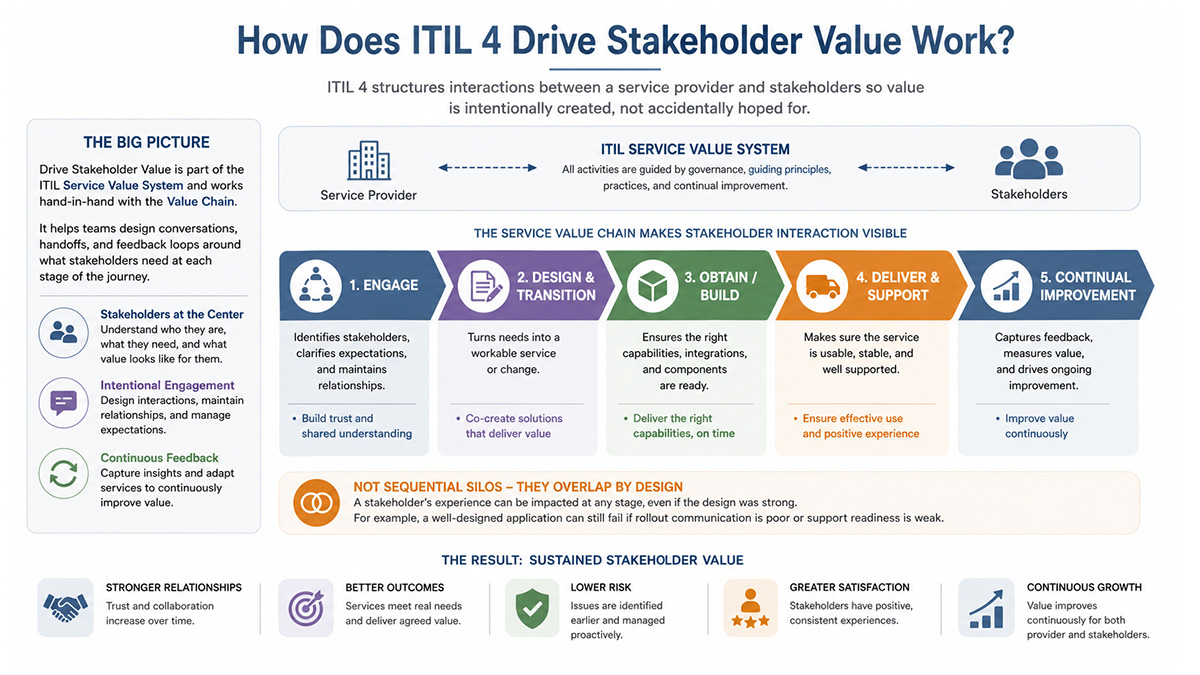
ITIL 4 Drive Stakeholder Value works by structuring the interactions between a service provider and its stakeholders so value is intentionally created, not accidentally hoped for. It gives teams a practical way to move from requirements gathering to ongoing relationship management.
The module is closely tied to the ITIL service value system and the value chain. In practice, it helps teams design conversations, handoffs, and feedback loops around what stakeholders need at each stage of the journey.
The service value chain makes stakeholder interaction visible
- Engage identifies stakeholders, clarifies expectations, and maintains relationships.
- Design and transition turns needs into a workable service or change.
- Obtain/build ensures the right capabilities, integrations, and components are ready.
- Deliver and support makes sure the service is usable, stable, and well supported.
These activities are not sequential silos. They overlap, and that is the point. A stakeholder’s experience can be damaged at any stage, even if the design was strong. For example, a well-designed application can still fail if the rollout communication is poor or if support readiness is weak.
Service relationships shape trust and collaboration
Service relationships are the ongoing interactions between providers, consumers, and other stakeholders. They shape trust, and trust shapes whether people will adopt the solution, report issues early, and participate in improvement work.
In an IT project, trust is built through predictable updates, clear ownership, honest risk reporting, and visible follow-through. If the project team hides bad news until the last minute, stakeholders stop treating the team like a partner and start treating it like a liability.
Customer journey, user experience, and service experience matter
Customer journey is the path a stakeholder follows from first contact through adoption and ongoing use. User experience is how easy and effective the service feels to the person using it. Service experience is broader and includes support interactions, communication, reporting, and recovery after problems.
That distinction matters in project environments. A user may like the screen layout but still judge the service negatively if the training was weak or the incident response process was frustrating. ITIL 4 Drive Stakeholder Value helps teams see the full journey, not just the software interface.
AXELOS and PeopleCert publish the official ITIL guidance that defines how value co-creation, service relationships, and stakeholder journeys fit into the broader ITIL model. For teams building stronger ITSM capability, that is the source of truth, not a set of generic project management slogans.
What Is Stakeholder Value in IT Projects?
Stakeholder value in IT projects is the benefit a stakeholder actually receives from the project’s result, and it includes the result itself plus the experience of using it. That means a feature, report, or workflow has to work in the real world, not just in the specification document.
Value can show up as faster service delivery, lower operating cost, fewer errors, improved compliance, better visibility, or less friction for end users. The same project can create multiple forms of value for different groups, which is why project teams need a layered view of success.
Examples of value that can conflict
- Speed versus governance: users want fast approvals, while compliance teams need audit trails.
- Usability versus control: a simple interface may hide fields needed by support or legal teams.
- Cost versus resilience: a cheaper option may increase downtime or manual effort later.
- Standardization versus flexibility: operations may need consistent processes, while business units want custom views.
This is where ITIL 4 value co-creation becomes practical. Teams do not wait until the end to discover what “good” means. They negotiate tradeoffs early, document them, and keep checking whether the chosen design still serves the business outcome.
NIST guidance on risk management and service resilience reinforces a simple idea: a valuable service must be both useful and dependable. A project that creates speed but weakens control is not necessarily valuable. A project that improves compliance but frustrates every user is also not valuable.
Identifying Stakeholders and Their Expectations
Stakeholder identification is the process of finding everyone who affects the project or is affected by it. That includes obvious groups like sponsors and users, but also less visible groups such as support analysts, security reviewers, compliance officers, and downstream teams.
A project that only listens to the loudest voices tends to miss the people who will actually carry the operational burden after go-live. Good Stakeholder Management starts with a deliberate map of influence, interest, power, and impact.
Map stakeholders beyond the obvious list
Many teams stop at the steering committee and the primary user group. That is too shallow. A service may be approved by leadership but rejected by the people who have to support it, reconcile it, secure it, or report on it.
- Identify primary stakeholders such as sponsors, users, and owners.
- Identify secondary stakeholders such as support teams, compliance reviewers, and partner organizations.
- Identify hidden stakeholders such as finance, legal, data governance, and downstream service owners.
- Assess influence and impact to prioritize engagement effort.
Capture expectations using more than one method
Interviews are useful, but they are rarely enough. People often say what they think they need, not what will actually solve the problem. Workshops, surveys, observation, and stakeholder registers help fill the gaps.
- Interviews uncover detail and politics.
- Workshops expose disagreements and dependencies.
- Surveys scale feedback across larger groups.
- Observation shows what people really do, not just what they say.
- Stakeholder registers keep roles, expectations, and concerns visible.
Pro Tip
When a stakeholder asks for a feature, ask what problem it solves, what workaround they use today, and what would make the current process unacceptable. That usually reveals the real requirement faster than a form ever will.
Sometimes the stated need is not the real need. A request for “more fields on the form” may actually mean the team needs fewer errors, better traceability, or easier review. Understanding the underlying need is what turns requirements gathering into actual value design.
Expectation conflicts are normal
Security requirements can slow down convenience. Speed can conflict with governance. Finance may want cost control while operations wants resilience. These tensions are not a sign that the project is broken; they are a sign that the project touches real business tradeoffs.
According to the ISACA governance perspective, value is created when control, risk, and performance are balanced rather than optimized in isolation. That is exactly the mindset needed for ITIL 4 and for strong Engagement Strategies.
Mapping the Stakeholder Journey
Stakeholder journey is the path a stakeholder takes as they discover, adopt, use, and evaluate a service or project result. It is not the same as a process map or project plan, because it focuses on experience from the stakeholder’s point of view.
A project plan shows tasks. A journey map shows moments that matter. That difference is critical if you want to improve adoption, reduce friction, and build trust.
Common journey stages in IT projects
- Awareness: stakeholders learn that change is coming.
- Onboarding: they receive access, training, and context.
- Adoption: they begin using the new service in real work.
- Daily use: they experience the service under normal pressure.
- Issue resolution: they seek help when something breaks or confuses them.
- Renewal or handoff: the service stabilizes, evolves, or transitions to steady-state ownership.
Each stage has different pain points. Awareness fails when communication is vague. Onboarding fails when access is delayed. Adoption fails when users are not trained on realistic scenarios. Daily use fails when the service is slower than the legacy workaround. Issue resolution fails when support is hard to reach or inconsistent.
Touchpoints reveal the moments that matter
Touchpoints are any interactions a stakeholder has with the project or service, including meetings, demos, emails, dashboards, training, portals, and support calls. These touchpoints shape confidence more than most teams realize.
Journey mapping helps surface emotional friction as well as operational friction. A stakeholder may accept a delay if they understand the reason and trust the team. The same delay can trigger resistance if it arrives with silence and uncertainty.
Journey maps also help prioritize improvement. If the highest-risk interaction is the first week after go-live, then that is where support staffing, training reinforcement, and issue triage should be focused. That is a practical service improvement decision, not a theoretical exercise.
Designing Value Co-Creation Into the Project
Value co-creation is the practice of shaping the solution with stakeholders instead of building it for them and asking for approval at the end. In ITIL 4, this is the right model because value is created through collaboration, not one-way delivery.
When stakeholders participate early, they help define what success looks like, identify tradeoffs, and reduce the risk of expensive rework later. That is especially important in IT projects where business workflows, technical constraints, and policy requirements collide.
Practical ways to co-create value
- Design thinking workshops to surface needs, pain points, and desired outcomes.
- Prototyping to validate ideas before full build work starts.
- Pilot releases to test the service with a real user group.
- Feedback loops to refine the solution based on actual use.
These methods work because they make hidden assumptions visible. A dashboard that looks useful in a mockup may be unreadable in practice. A workflow that passes technical review may fail because it adds too many manual steps. Early testing catches those issues while change is still cheap.
Balance stakeholder input with technical reality
Co-creation does not mean every request gets approved. Architecture standards, security requirements, budget limits, and platform constraints still matter. The goal is not to satisfy every preference; it is to make the best decision with the right people in the room.
- Use prototypes to show tradeoffs instead of arguing abstractly.
- Document decisions so stakeholders understand why a compromise was made.
- Keep architecture guardrails visible to avoid later rework.
- Invite users into pilots so feedback is grounded in reality.
Examples of co-creation in action include co-designing dashboard views with executives, building self-service options with service desk input, and refining reporting views with operations teams. That kind of collaboration supports Customer Focus because it respects how people actually work.
itSMF and ITIL practitioners often emphasize that service design succeeds when business users, support staff, and technical teams shape the service together. That principle also connects strongly to ITIL 4 and to the course concept of organized, measurable IT service management.
How Do You Improve Communication and Engagement?
Communication improves engagement when it is transparent, consistent, relevant, and timely. Stakeholders do not need more messages; they need better ones.
The fastest way to lose trust is to send generic updates that do not answer the questions people actually have. Good communication makes the right information visible to the right audience at the right time.
Tailor the message to the audience
- Executives need business impact, risk, decisions, and timeline confidence.
- End users need what is changing, when it changes, and what they need to do.
- Technical teams need dependencies, implementation detail, and escalation paths.
- Operational support needs runbooks, contact points, known issues, and readiness details.
That means one project does not need one communication plan. It needs a communication strategy with different messages for different stakeholder groups. A release note for users should look very different from a risk update for leadership.
Use the right channels for the job
Workshops are best for alignment. Demos are best for showing progress. Portals are best for self-service status and documentation. Chat tools are useful for fast coordination, but they are not a replacement for formal decisions or approvals.
Release notes, service notices, and status reports work best when they are short, predictable, and tied to action. If a user has to decode a long paragraph to find out whether they must do anything before go-live, the communication has already failed.
Engagement is not a communication volume problem. It is a relevance problem.
Expectation management prevents avoidable conflict
Stakeholders can accept bad news much more easily than surprise news. When scope changes, risks emerge, or dependencies slip, the team should communicate early and plainly.
Regular show-and-tell demos, stakeholder champions, and structured feedback sessions are simple tactics that increase participation. They also make hidden frustration visible before it turns into resistance. That is the kind of engagement strategy that supports service improvement rather than reactive cleanup.
SHRM guidance on organizational change consistently reinforces that people support what they understand and help shape. That principle applies directly to IT projects, especially when change affects daily work and service experience.
Measuring Stakeholder Value and Experience
Measurement tells you whether the project created real stakeholder value or just activity. If you only track task completion, you can end up with a green project that delivers a poor experience.
The right metrics combine business outcomes, service performance, and human feedback. That balance is what separates meaningful value measurement from vanity reporting.
Track both quantitative and qualitative measures
- Adoption rate: how many stakeholders actually use the solution.
- Satisfaction score: how stakeholders rate the experience.
- Response time: how quickly the team resolves issues or fulfills requests.
- Business outcome: whether the project improved a target KPI.
- Support ticket trend: whether incidents, complaints, or repeat contacts are rising or falling.
Quantitative data shows scale. Qualitative feedback explains why the numbers look the way they do. A high adoption rate may hide frustration if users are forced to adopt but still prefer the old process. A low satisfaction score may point to training problems even when the technical service is stable.
Measure experience at key journey points
Experience checks work best when they happen at moments that matter: after training, after go-live, after issue resolution, and after the first month of use. Those checkpoints tell you whether confidence is rising or falling.
Dashboards and scorecards help leaders see trends over time. But they must reflect stakeholder value, not just project progress. A dashboard full of completed tasks and on-time milestones does not prove that the business got what it needed.
| Project progress metric | Shows whether work is being completed |
|---|---|
| Stakeholder value metric | Shows whether the completed work is producing useful outcomes |
IBM Cost of a Data Breach Report and Verizon Data Breach Investigations Report both show that weak processes and human error have measurable business impact. That is a reminder that service experience, support quality, and stakeholder behavior are not soft issues. They affect real cost and real risk.
Warning
Do not confuse activity with value. A project can hit every milestone and still fail if users avoid the solution, support costs rise, or the business outcome never materializes.
How Do You Manage Risks, Issues, and Resistance?
Resistance is the pushback stakeholders show when a change feels risky, unclear, or disruptive. It is common, and it usually signals a problem in design, communication, usability, or trust.
If you ignore resistance, it grows underground. If you understand it early, you can often turn it into useful feedback. That is one of the more practical reasons ITIL 4 Drive Stakeholder Value matters in IT projects.
Common sources of resistance
- Change fatigue from too many shifts in a short period.
- Fear of job impact when automation or redesign changes roles.
- Lack of trust because previous projects overpromised and underdelivered.
- Poor usability that makes the new service harder than the old one.
Resistance is not always emotional. Sometimes it is rational. If a workflow adds three approvals and a manual workaround, people will reject it because it increases effort, not because they dislike change.
Use ITIL practices to reduce risk
Several ITIL practices support stakeholder value directly. Incident management restores service quickly. Problem management removes root causes. Change enablement reduces risk in releases. Service level management makes performance expectations explicit.
When those practices work together, stakeholders experience fewer surprises and more confidence. That is what makes service management valuable in project environments instead of just operational environments.
Mitigation should be tied to the user experience
Good risk mitigation is not only about technical safeguards. It is also about what the stakeholder experiences before, during, and after the change.
- Provide training plans that match actual workflows.
- Use phased rollout to reduce blast radius and learn early.
- Confirm support readiness before go-live.
- Monitor feedback early and act on negative patterns quickly.
CISA guidance on operational resilience reinforces a useful point: the best time to address risk is before people are already frustrated. In project work, that means listening to negative feedback early, not defensively.
What Happens After Go-Live?
Continuous improvement is the process of using feedback, data, and service reviews to make the solution better after deployment. Value realization does not stop at go-live because stakeholder expectations change once the service enters daily use.
Many projects treat go-live like the finish line. In reality, it is the first real test. Users reveal friction points, support teams uncover pattern issues, and sponsors start judging whether the promised benefits actually show up.
Use reviews to turn experience into action
- Post-implementation reviews identify what worked, what failed, and what needs correction.
- Retrospectives capture team learning while details are still fresh.
- Service reviews track whether operational performance meets stakeholder expectations.
The best improvements usually come from repeated small findings, not dramatic one-time complaints. If five users each raise a different issue about the same screen, that may signal one deeper usability problem rather than five separate defects.
Feed improvement into the operating model
Stakeholder feedback should land somewhere actionable, such as a product backlog, a change pipeline, or a continuous improvement register. If feedback sits in meeting notes, it will be forgotten.
Prioritization should consider business impact, user pain, and operational effort. A change that removes a daily workaround for 200 users may be more valuable than a cosmetic enhancement that only helps one manager.
Continuous improvement builds long-term trust because stakeholders see that their feedback matters. It also strengthens service maturity, reduces repeated friction, and makes future change easier to accept. That is the practical link between Service Improvement, adoption, and sustained project benefits.
NICE and the NICE/NIST Workforce Framework both reinforce the idea that capability grows through defined tasks, feedback, and role clarity. In service management terms, the same logic applies after go-live: improvement is a discipline, not a cleanup activity.
Key Takeaway
- IT project success is measured by stakeholder value, not delivery alone. A project can be on time and still fail if adoption is low or outcomes do not improve.
- ITIL 4 Drive Stakeholder Value makes value co-creation practical. It helps teams manage expectations, journeys, communication, and service experience.
- Stakeholder journeys expose the moments that matter. Awareness, onboarding, adoption, support, and renewal each need different engagement strategies.
- Measurement must combine numbers and feedback. Adoption, satisfaction, support trends, and business outcomes tell a fuller story than project status alone.
- Continuous improvement is part of value delivery. Go-live is not the end; it is the point where real stakeholder experience starts.
ITSM – Independent Training Based on the ITIL® 4 and Version 5 Framework
Learn essential IT service management skills using the ITIL 4 framework to improve operations, resolve issues efficiently, and prevent future problems.
View Course →Conclusion
IT projects succeed when they deliver meaningful value to stakeholders, not just technical completion. That means understanding what different groups need, mapping their journeys, designing the service with them, and measuring whether the change actually improves work, trust, and outcomes.
ITIL 4 Drive Stakeholder Value gives teams a practical way to do exactly that. It connects Stakeholder Management, Customer Focus, Service Improvement, and Engagement Strategies into one repeatable approach that works before go-live and after it.
If your team is building stronger service management capability, apply stakeholder-centric thinking from project initiation through handoff and steady state. Use journey maps, honest communication, meaningful metrics, and feedback-driven improvement to keep value visible. That is the difference between shipping a project and delivering a result people actually want to use.
CompTIA®, Cisco®, Microsoft®, AWS®, ISC2®, ISACA®, and PMI® are trademarks of their respective owners.
