DMAIC is the Six Sigma method IT teams use to fix recurring process problems with facts instead of guesswork. It helps you define the issue, measure current performance, analyze root causes, improve the workflow, and control the gains so they stick. If you need better incident management, change control, service delivery, or software release quality, the six sigma dmaic approach can be used when the problem is measurable and the improvement needs to last.
Six Sigma Black Belt Training
Learn advanced Six Sigma Black Belt methodologies to identify, measure, and solve process issues, driving measurable improvements and operational excellence.
Get this course on Udemy at the lowest price →Quick Answer
DMAIC is a structured, data-driven framework for process improvement in IT. It is used to reduce waste, errors, and rework by moving from vague complaints to measurable fixes. In IT operations, it works especially well for recurring incidents, slow ticket resolution, failed changes, and release defects because each step creates evidence you can act on.
Definition
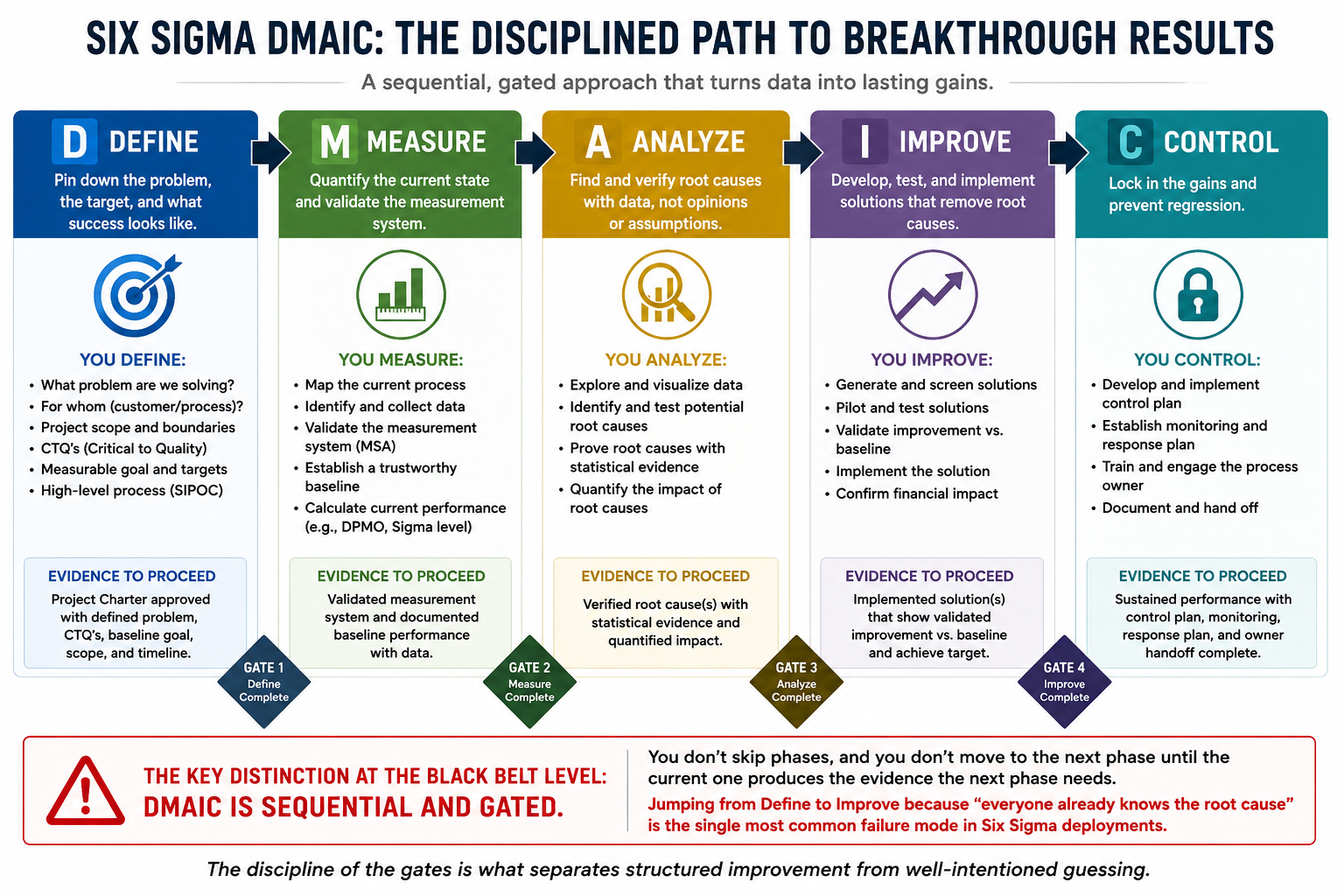
DMAIC is the Define, Measure, Analyze, Improve, and Control framework used in Six Sigma to solve process problems with data. In IT, it provides a repeatable way to improve service delivery, reduce defects, and keep a better process from slipping back into old habits.
| DMAIC Stages | Define, Measure, Analyze, Improve, Control |
|---|---|
| Best Use Case | Recurring, measurable process problems in IT operations and service delivery |
| Typical Metrics | Cycle time, MTTR, backlog size, SLA compliance, defect rate |
| Core Strength | Turns subjective complaints into data-backed improvement decisions |
| Common IT Areas | Incident management, change management, release management, service request fulfillment |
| Outcome | Sustainable process improvement with controls that prevent regression |
What Is DMAIC in IT Process Improvement?
DMAIC is a framework for process improvement that works well when a team knows something is broken but does not yet know exactly why. In IT, that usually shows up as repeated outages, slow resolution times, messy change approvals, or release failures that keep coming back.
The value of DMAIC is simple: it forces teams to stop arguing from opinion and start working from evidence. That matters in incident management, service delivery, and governance because the same problem often gets described differently by support, operations, leadership, and end users.
Process improvement in IT is not just about making work faster. It is about reducing rework, cutting waste, improving consistency, and making sure the result is stable enough to support data-driven decision making.
The six sigma dmaic approach can be used when you need a repeatable method for a problem with measurable outputs. It is especially useful when a team is stuck in reactive mode and needs a structured way to move from symptoms to root causes.
DMAIC is not a theory exercise. It is a practical way to make IT work less chaotic by tying every change to a measurable business result.
According to the official Six Sigma overview from iSixSigma, DMAIC remains one of the most widely used improvement models because it is straightforward to apply across many operational environments. For IT teams, that means the same method can be used in help desk operations, infrastructure reliability work, and release quality reviews.
How Does DMAIC Work?
DMAIC works by forcing each stage to answer one specific question before the team moves to the next. That discipline is what keeps projects from becoming vague, biased, or overengineered.
-
Define the problem clearly. This is where you identify what is happening, who is affected, and why the issue matters to the business.
-
Measure the current process. You document how work really flows and collect baseline metrics such as ticket cycle time, defect rate, downtime, or SLA performance.
-
Analyze the causes. This is where root cause analysis begins, using tools like the 5 Whys, Pareto charts, and process mapping to find the real drivers behind the problem.
-
Improve the process. Teams design and test changes that remove the cause, not just the symptom, such as automation, workflow redesign, or updated standards.
-
Control the result. The new process is monitored with dashboards, thresholds, SOPs, and ownership so performance does not drift back.
This sequence matters because skipping a step usually creates weak results. If you jump straight to Improve, you may automate the wrong thing. If you skip Control, the team often slides back to the same failure pattern within a few months.
The Project Management Institute discusses disciplined problem solving and project planning in a way that aligns with the structure of DMAIC. See PMI for broader project governance principles that complement process improvement work.
Define The Problem Clearly
The Define stage is where many IT improvement efforts succeed or fail. If the problem statement is vague, every later decision becomes fuzzy, and the team ends up fixing opinions instead of defects.
A good problem statement translates a complaint into an operational issue. For example, “the help desk is too slow” is not precise enough. “Average first-contact resolution dropped from 68% to 54% over the last two quarters, increasing escalations and user callbacks” is far more useful because it has scope, impact, and a measurable gap.
Turn complaints into a business problem
Stakeholders often describe the pain in emotional terms. That is normal. Your job is to translate that into an IT problem that can be measured, traced, and fixed.
- Complaint: Users keep complaining about slow support.
- IT problem: Ticket resolution time exceeds the service target for priority two incidents.
- Business impact: Delays are affecting employee productivity and increasing repeat contacts.
Identify the people affected
DMAIC works better when you identify customers and stakeholders early. In IT, that usually includes end users, service owners, support agents, infrastructure teams, application owners, compliance leaders, and business managers.
A stakeholder map helps you see who cares about speed, quality, risk, or cost. That matters because an improvement that helps the service desk might create extra work for release management or security review if you do not design it carefully.
Use boundaries so the project stays focused
Scope control is a major part of good project management. A project that starts with “fix our whole support model” is too broad to succeed. A better boundary is “reduce password reset tickets by improving self-service and knowledge base accuracy for one business unit.”
Tools such as a project charter and framework diagrams such as SIPOC help create shared understanding. SIPOC stands for suppliers, inputs, process, outputs, and customers, and it is useful when multiple teams disagree on where the process begins and ends.
Pro Tip
If the problem statement cannot fit on one screen and include who, what, where, and how much, it is probably too broad for a DMAIC project.
For process governance and service management alignment, the AXELOS ITIL guidance is a useful reference point because it emphasizes defined service outcomes, accountability, and repeatable workflows.
Measure The Current Process
The Measure stage establishes a baseline. Without a baseline, nobody can prove whether an improvement worked, and every debate turns into guesswork.
For IT teams, measurement starts with documenting how work actually flows. A flowchart, swimlane diagram, or value stream map makes the hidden handoffs visible. That matters because delays often happen between teams, not inside a single team’s task list.
Capture the right metrics
Good metrics depend on the problem you are trying to solve. A ticket backlog issue needs different measures than a release failure problem.
- Cycle time: How long it takes to complete a request or incident.
- First-contact resolution: The percentage of issues resolved without escalation.
- Downtime: How long a service is unavailable or degraded.
- Backlog size: The count of unresolved tickets waiting for action.
- Defect rate: The number of errors found in releases, code, or operational output.
- SLA compliance: The percentage of work completed within the service target.
Check data quality before you trust the numbers
Data quality is the accuracy, completeness, and consistency of the data used for analysis. If ticket categories are messy, timestamps are missing, or agents use labels differently, your conclusions will be weak.
Validate the data before you build charts. Compare records across the ticketing system, logs, monitoring tools, CMDB entries, and release records. If one system says a change was completed at 2:00 p.m. and another says 3:15 p.m., you need to resolve the discrepancy before using the data for decision making.
The official guidance from NIST is useful here because measurement discipline and traceability are central to reliable operational improvement work. NIST standards and publications are also widely used when IT teams need credible control and assessment methods.
| Measurement Source | What it tells you |
|---|---|
| Ticketing system | Volume, resolution time, reassignment patterns, backlog trends |
| Monitoring tools | Availability, alerts, threshold breaches, mean time to detect |
| Logs | Error patterns, transaction failures, system behavior over time |
| CMDB | Service relationships, impacted assets, dependency mapping |
| Release records | Change volume, failure rate, rollback frequency, approval timing |
Establishing baseline performance lets you compare teams, systems, or time periods in a defensible way. For example, you can compare MTTR by application group, or measure whether one support shift closes tickets faster than another because of better routing, better documentation, or simply lower complexity.
Analyze Root Causes
Analyze is where teams stop treating symptoms as the problem. A recurring outage is not always a network issue, and a slow ticket queue is not always a staffing issue.
Root cause analysis is the process of identifying the underlying reason a problem exists. In IT, the cause may be technical, procedural, human, or policy-driven. The real answer is often a combination of all four.
Use tools that separate signal from noise
- 5 Whys: Keep asking why until the chain points to a controllable cause.
- Fishbone diagram: Organize causes by people, process, tools, environment, and policy.
- Pareto analysis: Find the small number of causes creating most of the pain.
- Process decomposition: Break a workflow into smaller steps to see where delay or error occurs.
Segment the data before you draw conclusions
One of the fastest ways to misread IT performance is to average everything together. Segment by category, service type, shift, location, application, or user group. A problem that appears “random” often becomes obvious once you compare one site or one queue against another.
For example, if password reset tickets spike only during Monday morning shifts, the issue may not be training. It may be onboarding gaps, poor self-service adoption, or a workflow that fails under peak demand.
Watch the difference between correlation and causation
A chart can show that ticket volume rises when uptime drops, but that does not prove tickets caused the outage or the outage caused the tickets. Good analysts test whether the pattern is reproducible, whether a process change preceded the shift, and whether another variable explains the result.
A classic example is recurring incidents tied to weak Knowledge Base articles, poor monitoring thresholds, or inconsistent handoffs between teams. The visible symptom is “too many repeat incidents,” but the real cause may be unclear troubleshooting steps, alert fatigue, or missing ownership during escalation.
When the same issue keeps coming back, the most expensive mistake is usually fixing the symptom faster instead of fixing the cause correctly.
For analysis methods and operational examples, the Six Sigma Society and SANS Institute both reinforce the value of structured analysis in high-stakes operational environments, especially where repeat failures have real business cost.
Improve The Process
The Improve stage is where analysis becomes action. The goal is not to make the workflow feel better on paper. The goal is to remove the cause and prove that the change improves performance.
Effective improvements address the root cause directly. If release failures are caused by inconsistent handoffs, then adding more approvals may make the process slower without making it safer. If ticket delays are caused by poor classification, then automation alone will not solve it unless the intake data improves too.
Design changes that fit the actual cause
Improvement ideas should come from workshops, brainstorming sessions, field observations, and stakeholder review. The people doing the work often know where the process breaks down, but they need a structured way to surface those insights.
- Automation: Auto-routing tickets, pre-checking changes, or triggering alerts from known conditions.
- Standard templates: Consistent intake forms, change records, or incident summaries.
- Knowledge base updates: Clear troubleshooting steps and verified fixes.
- Change approval redesign: Simplify approvals for low-risk changes while keeping control on high-risk work.
- Alert tuning: Remove noisy notifications and tighten thresholds around meaningful events.
Use pilots before a broad rollout
Quick wins matter, but they should still be controlled. Pilot the change in one team, one service, or one shift before rolling it out widely. That lets you measure the impact, identify unintended consequences, and adjust the process before the whole organization adopts it.
Choose improvements based on effort, risk, cost, and expected performance gain. A low-effort change with a clear impact, such as standardizing incident categories, is often the best place to start because it builds momentum without creating major disruption.
Microsoft’s operational guidance for process and service tooling is useful for teams implementing change in real environments; see Microsoft Learn for vendor documentation that supports practical process execution and service administration.
Warning
Do not confuse a workaround with an improvement. A workaround helps one case; a real improvement reduces the cause across the process.
Control And Sustain The Gains
The Control stage keeps the new process from drifting back to the old one. That is where many improvement projects fail, especially when the team celebrates the fix but does not build a system to hold it in place.
Control means making the new method visible, measurable, and owned. If the process changes but nobody monitors it, the organization will eventually revert to the path of least resistance.
Put controls into the workflow
- Dashboards: Show live or weekly performance against the target.
- Control charts: Highlight whether variation is normal or a real signal of drift.
- Standard operating procedures: Document the approved way to do the work.
- Audit checks: Verify the process is being followed correctly.
- Ownership assignments: Make one team or role accountable for sustainment.
Build sustainment into training and governance
Embed the new process into onboarding, reference guides, and team training so the improvement survives staff turnover. This is especially important in service management environments where new hires often learn by copying existing habits.
Governance matters too. A good governance model keeps the process aligned with business goals, security requirements, and service standards. The ISO/IEC 27001 family is a useful reference when improvement work touches control discipline, risk reduction, or operational consistency.
Trigger thresholds and escalation paths should be defined in advance. For example, if ticket backlog rises above a set limit for two consecutive days, the service owner may review staffing, routing, or categorization. If failed changes exceed the threshold in a release window, the change board may pause deployment until the cause is understood.
A data-driven decision making approach works best here because the team is reacting to signals, not opinions. The more clearly a process is controlled, the less likely it is to decay after the project closes.
Applying DMAIC Across Common IT Use Cases
DMAIC fits a range of IT use cases because most operational problems have measurable output, repeated workflow steps, and a need for sustainment. It is especially strong when the team must improve a process without replacing the entire operating model.
Incident management and service requests
In Incident Management, DMAIC can reduce MTTR, improve first-contact resolution, and lower repeat incidents. In service request fulfillment, it can shorten approval time, reduce rework, and improve customer satisfaction by simplifying intake and routing.
Change management and release management
In Change Management, DMAIC can cut failed changes and reduce emergency changes by improving review quality and risk screening. In Release Management, it helps identify where defects enter the pipeline and where approval or testing bottlenecks slow delivery.
Strategic transformation work
DMAIC is not limited to day-to-day operations. It can support cloud migration, security hardening, and platform modernization when the work includes measurable workflow issues, such as provisioning delays, change failures, or inconsistent validation steps. It works well alongside Agile, DevOps, and Lean because it fills a different role: it is the method for disciplined process repair, not a replacement for delivery practices.
The ITIL body of practice and the Lean Enterprise Institute both reinforce principles that align with DMAIC, especially waste reduction, workflow clarity, and continuous improvement. The difference is that DMAIC insists on measurable baseline data and formal sustainment.
Which projects are best suited to DMAIC?
- Good fit: Recurring issues, measurable pain, stable process, unclear root cause.
- Good fit: Ticket backlog, release defects, approval delays, recurring incidents, repeated manual rework.
- Poor fit: One-time crises with no repeatable process to improve.
- Poor fit: Projects where the objective is pure exploration rather than operational change.
The six sigma dmaic approach can be used when you need controlled, measurable improvement rather than a one-off fix. That is why it fits so well with the kind of work covered in ITU Online IT Training’s Six Sigma Black Belt Training course, where analysts and leaders learn to identify, analyze, and improve critical processes with evidence.
Common Challenges And How To Avoid Them
DMAIC sounds simple until the real-world friction shows up. Most failed projects do not fail because the method is bad. They fail because the team skips discipline in one of the five stages.
Common mistakes
- Weak problem definition: The project starts broad and never narrows to a measurable issue.
- Poor data: The analysis is based on incomplete or inconsistent records.
- Overcomplicated analysis: The team keeps collecting data instead of acting on what is already clear.
- Solution bias: Leaders push a preferred fix before the root cause is known.
- Metric conflict: The team improves speed while damaging quality or stability.
Manage resistance the practical way
Teams often resist improvement work because they think it means blame, extra reporting, or more overhead. The best answer is transparency. Explain the business problem, the metric being improved, and how the team will know the change worked.
Executive sponsorship helps because improvement projects cut across team boundaries. Without leadership support, the effort can stall when one group is asked to change a habit that benefits the larger organization.
Cross-functional collaboration is essential when the process includes operations, security, service desk, application owners, and governance. If each group solves its own piece in isolation, the result may optimize local performance while making the overall workflow worse.
Realistic timelines matter too. A DMAIC project is not a quick patch. It is a disciplined improvement cycle, and that takes time to define, measure, test, and control properly.
For workforce and process discipline context, the NIST and CISA guidance on operational resilience and process maturity is a strong reminder that repeatable controls are part of reliable IT performance, not an optional extra.
Key Takeaway
DMAIC gives IT teams a repeatable method for solving measurable process problems.
The Define stage narrows the issue so the team works on the right problem.
The Measure and Analyze stages turn ticket data, logs, and workflow evidence into root-cause insight.
The Improve and Control stages create changes that stick instead of slipping back.
DMAIC works best on recurring operational problems with clear metrics and real business impact.
Six Sigma Black Belt Training
Learn advanced Six Sigma Black Belt methodologies to identify, measure, and solve process issues, driving measurable improvements and operational excellence.
Get this course on Udemy at the lowest price →Conclusion
DMAIC gives IT teams a disciplined way to improve processes with evidence instead of guesswork. It is especially effective when the problem is recurring, measurable, and costly enough to justify a structured fix.
Define clarifies the business problem, Measure creates a baseline, Analyze finds the real cause, Improve designs a better workflow, and Control keeps the gains in place. That sequence is what turns a temporary fix into a sustainable operational improvement.
If you want to get value from DMAIC quickly, start with one narrow, high-impact problem. Choose something like recurring ticket delays, failed changes, or repeated incidents, and build momentum from a small win before expanding to larger service management goals.
The strongest next step is simple: identify one recurring IT process issue in your environment and test whether the six sigma dmaic approach can be used when you need measurable, lasting improvement. That is the kind of work where ITU Online IT Training’s Six Sigma Black Belt Training becomes immediately practical.
CompTIA®, Microsoft®, AWS®, Cisco®, PMI®, ISACA®, and EC-Council® are trademarks of their respective owners.
